
Introduction
When government actions affect my friends, out-of-pocket costs, and community health, I read and ask questions. Rarely can we draw direct lines in real time, but today I paid $3.90 per gallon for unleaded gas in Georgia (while measles and cyclosporiasis cases surge). According to AAA, the average price in Georgia is $3.92 per gallon. One year ago, it was $2.92, meaning gas prices in my state are now 34% higher. Nationally, the average price is $4.11, up 30% year-over-year.
It Gets Worse
Interestingly, gas prices were trending down this time last year and through February 2026. Then, on February 28th, the United States and Israel initiated joint strikes on Iranian and regional infrastructure targets. These military operations and retaliatory attacks spread, affecting families, trade, and markets around the world, in addition to freezing transport through the Strait of Hormuz. Since the start of this escapade, gas prices in Georgia and the U.S. are up 46% and 38% respectively (table).
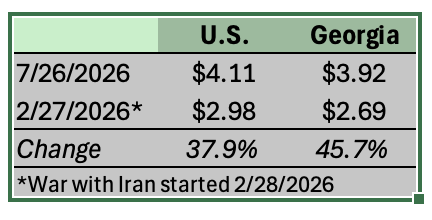
Figure: Average Unleaded Gasoline Prices in the U.S., $/gallon
Data Source: AAA
Keeping things practical, the average driver in the U.S. buys 10 to 12 gallons of gas for their car two to four times per month. That means, today, we now spend $10 to $15 more per week each time we go to the pump than in February.
Stop Digging
Do we understand where we are? The U.S. Government spends money it does not have while requesting additional funds for U.S. war efforts in Iran. In a recent post about the bond market and U.S. Federal Debt, I noted how the U.S. debt is about 22% bigger than the U.S. economy. On an annual basis, using numbers from the U.S. Debt Clock, the U.S. Government is spending just over $7.2 trillion and bringing in just under $5.6 trillion, producing a 2026 budget deficit of over $1.6 trillion.
Dividing those numbers by 365 implies that the folks we elected in Washington, D.C. spend $19.7 billion dollars per day while collecting $15.3 billion in revenue (mostly from income and payroll taxes). How do our representatives cover the $4 to $5 billion daily deficit? The U.S. Treasury issues securities to borrow money.
So where are we? The U.S. planned to spend $1 trillion or more on each of four things in 2026: Social Security (~$1.7 trillion); Net Interest on Debt (~$1.1 trillion); Medicare (>$1.0 trillion); and Medicaid and other health programs (>$1.0 trillion). With the war in Iran, on which we spend another $1 to $2 billion per day, total National Defense expenditures will also exceed $1 trillion in 2026. In effect, as we deplete our munitions, each incremental dollar spent in Iran is borrowed.
Conclusion
What do we get for this deficit spending? To what do we contribute when paying a “war tax” when fueling our cars and trucks? To the extent that borrowed funds go into programs that “generate returns” through supporting and securing the growth, health, and performance of individuals and businesses, then we are better off. To the extent we fund feckless follies, we steal from our children.
0 Comments